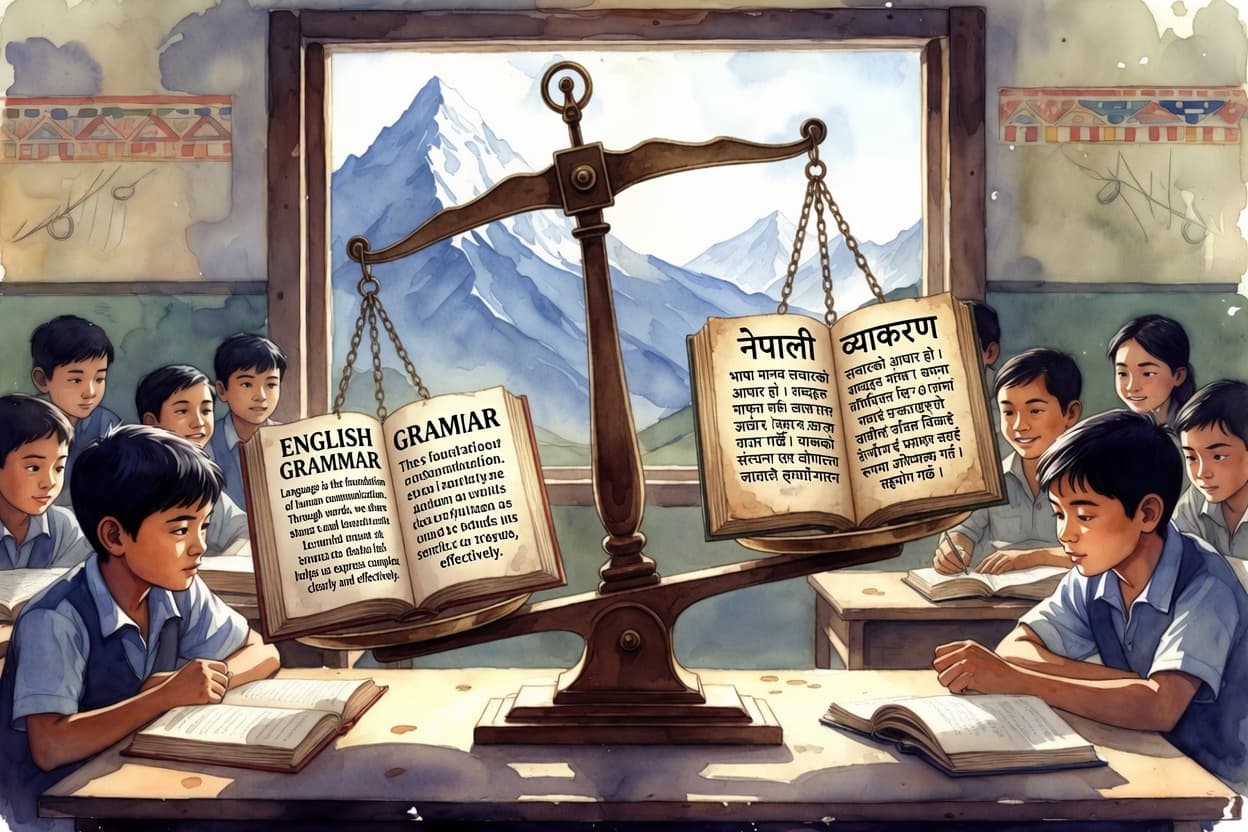
Has English-Medium Education Made Us Undervalue Our Own Language?
The state of our education system and society’s attitude toward language often raises concern. Over the years, English has become more than just a foreign language in Nepal. For many people, it has come to represent education, social status and success. This raises an important question: has the rise of English-medium education contributed to a gradual undervaluing of our own mother language?
Nepal is not a linguistically uniform country. The 2011 national census recorded more than 120 mother tongues, with Nepali spoken natively by less than half of the population. Despite this diversity, Nepali functions as a common language that connects different communities. In such a multilingual setting, the language of education plays a crucial role in shaping access, comprehension and identity.
At the same time, the education system has changed significantly in recent decades. According to World Bank data, by 2020 around one in four primary school students in Nepal was enrolled in private schools, the majority of which use English as the medium of instruction. Following policy changes that allowed schools to choose their instructional language, English-medium education has also expanded in public institutions. This has gradually increased the dominance of English in formal education.
In many classrooms, especially private schools, students are encouraged or even required to communicate in English. This creates an environment where English is often associated with intelligence and opportunity, while Nepali is sometimes treated as less important. As a result, many students become more comfortable expressing academic ideas in English than in their own language.
Research in Nepal and similar multilingual contexts suggests that language of instruction significantly affects learning outcomes. Studies have found that children taught in languages different from their home language are more likely to struggle academically, including higher rates of repetition and dropout. At the same time, mother-tongue-based multilingual education programs in Nepal have reported improved outcomes. According to International Academic Forum conference release, enrollment increased from about 90% to 98%, while dropout rates decreased from around 13% to 5% after implementation of such programs.
This evidence aligns with broader global findings. UNESCO has reported that a large portion of the world’s population still lacks access to education in a language they fully understand. It also highlights that children learn to read with greater comprehension when taught in familiar languages during early education. These findings suggest that language accessibility is not only a cultural issue but also a major educational factor.
Beyond classrooms, language influence extends into cultural life. A large number of young people in Nepal consume foreign media such as Hindi films, Korean dramas, and English content more frequently than Nepali films. This is influenced by multiple factors, including production quality, global distribution and exposure. However, language plays a subtle role as well. When education and daily academic life are dominated by English, foreign languages often feel more natural and familiar in media consumption. Over time, this can reduce consistent engagement with Nepali-language content.
This does not mean Nepali media lacks value. Rather, it reflects a broader shift in attention shaped by global cultural flow and linguistic comfort. As foreign languages become more embedded in education and entertainment, they naturally gain stronger influence in everyday life. None of this implies that English is harmful. English is an important global language that provides access to science, technology, higher education, and international communication. Every student should have the opportunity to learn it effectively.
However, learning English and replacing Nepali as a medium of education are not the same thing. A student should be able to study subjects such as occupation, science and mathematics in Nepali without feeling academically disadvantaged. A language should function as a bridge to knowledge, not a barrier to it.
Some may argue that Nepal’s multilingual nature makes a single-language education system impractical. This is a valid concern. Strengthening Nepali as a shared academic language does not mean weakening other mother tongues such as Maithili, Bhojpuri, Tharu, Tamang, Newari and other languages. In fact, research on multilingual education suggests that students benefit most when their first language is respected alongside a common instructional language. Thus, it promotes patriotism.
If Nepal aims to preserve both linguistic diversity and educational quality, the focus should not be on eliminating English, but on balancing it. Nepali must be strengthened as an academic language, while English remains an important skill rather than a status symbol.
Ironically, this discussion is being presented in English. The reason is simple: English is currently the most accessible language for reaching a wide audience, especially in digital spaces. That reality itself reflects the linguistic shift this article is trying to highlight.
English should remain a tool for communication and opportunity. Nepali, however, should remain a living language of education, thought, and expression. Preserving that balance is not just about language. It is about identity, accessibility, and the way future generations understand their own voice.